
Beyond Beauty:
What Makes a Jewel Truly Collectible?
The Qualities Serious Collectors Look For
September 2, 2026 | by The Crevoshay Studio
A remarkable jewel can stop us in our tracks.
Color, light, rarity, craftsmanship, and imagination come together in an object small enough to hold in the hand, yet powerful enough to become a work of art, a personal treasure, and eventually part of a collector’s legacy.
For some collectors, beauty may be where the attraction begins. But what makes a jewel truly collectible goes much deeper.
Collectibility can emerge from a combination of artistic authorship, rarity, exceptional gemstones, craftsmanship, provenance, cultural significance, and the story of the jewel itself.
In that sense, collecting important jewelry has much in common with collecting painting, sculpture, or other works of art. The materials matter, but so does the person who transformed them.
For artist Paula Crevoshay, that distinction is fundamental. A gemstone is not simply a precious material waiting to be placed into a setting. It can be the beginning of an artistic idea, a color relationship, a memory of nature, or the spark that leads to an entirely new composition.
So what transforms a beautiful jewel into something worth collecting?
1. The Artist Behind the Jewel
One of the first distinctions serious collectors make is between a beautiful object and a work that carries a recognizable artistic point of view.
Authorship matters.
Over time, important jewelry artists develop a visual language that can make their work recognizable before the viewer even sees a signature.

In Crevoshay’s work, that language appears through extraordinary color, nature-inspired forms, unusual gemstones, and compositions that often blur the line between fine jewelry and miniature sculpture.
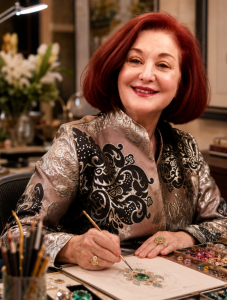
Paula Crevoshay describes herself first and foremost as an artist. That perspective shapes the entire creative process.
Rather than beginning with the question, “What kind of jewelry should I make?”, the process may begin with a gemstone, a color relationship, a flower, a creature, a landscape, or an idea she feels compelled to translate into three-dimensional form.
That is part of the joy of encountering an artist-created jewel. The collector is not only seeing precious materials beautifully assembled. They are seeing the world through someone else’s eyes.
What should collectors look for?
Ask whether the artist has developed a distinctive visual identity.
Can you recognize recurring ideas, techniques, forms, or color relationships across the body of work?
Does the jewel express the artist’s point of view, or could essentially the same piece have been created by anyone?
2. Rarity Goes Beyond the Rarity of the Gemstone
Rarity is often discussed in terms of gemstones: scarcity, origin, size, color, or quality.
But in an artist-created jewel, rarity can exist on several levels at once.
A particular gemstone may itself be difficult to obtain. But the complete composition may be even more difficult to reproduce.
Rarity is not simply how scarce the materials are.
It can also be how unlikely it would be for that exact artistic idea to ever exist again.
Paula frequently works with unusual stones, unexpected color combinations, and individual gems whose shape or visual character directly influences the finished design.
That means a one-of-a-kind jewel may be impossible to recreate precisely, even if an artist wanted to make a second version.
The exact center stone may no longer exist. Matching surrounding gemstones may be unavailable. A natural inclusion, unusual cut, optical effect, or subtle variation in color may have inspired the entire composition.
This is one of the pleasures of collecting truly individual work: knowing that the piece exists because a very particular set of materials, ideas, and artistic decisions came together at one moment.
3. Exceptional Gemstones Are About More Than Specifications
Serious collectors often ask what makes one gemstone more exceptional than another.
Traditional gemological characteristics certainly matter. Color, clarity, size, cut, origin, rarity, and treatment can all help establish a stone’s importance.
But an artist may see something else.

Paula has long been drawn to gemstones not only because of conventional measures of perfection, but because of what they make possible artistically.
A stone may have a color she has never seen before.
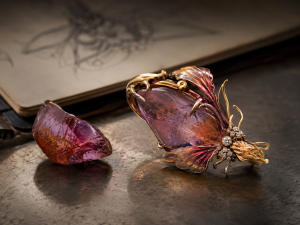
An unusual shape may immediately suggest the wing of an insect, the center of a flower, or the beginning of an entirely new composition.
An inclusion that another person might consider an imperfection may give the stone character, movement, or personality.
This is one of the differences between evaluating a gemstone only as a commodity and looking at it through the eyes of an artist.
A collector can therefore ask two different questions:
How exceptional is this gemstone gemologically?
What did the artist see in this particular gemstone that caused it to become part of this particular work?
For an artist-created jewel, both answers matter.
Sometimes the most memorable stone is not simply the most conventionally perfect one. It is the one that gave the artist something irresistible to respond to.
4. Color Can Become Part of the Artist’s Signature
Color is one of the most immediately recognizable characteristics of Crevoshay’s work.
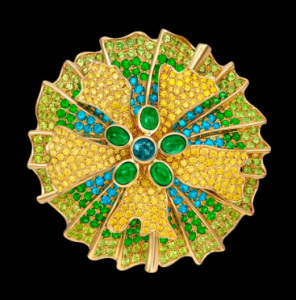
Paula does not simply add color to a finished design. She composes with it.

Gemstones become a painter’s palette.
A jewel may bring together colors that would rarely appear beside one another in traditional fine jewelry, yet feel completely natural when considered through the relationships Paula sees in flowers, animals, landscapes, and other forms in nature.
Primary colors interact with secondary and tertiary colors. Transparent stones behave differently from opaque ones. Light moves through one gemstone and reflects from another. Slight changes in saturation can alter the balance of the entire piece.
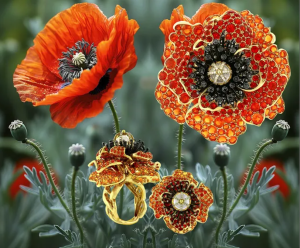
The result can feel exuberant, unexpected, and alive. This makes color part of the composition itself.
For collectors, that offers another way of looking beyond carat weight and material value.
A collector can ask:
Could the substitution of even one gemstone significantly change the artistic character of the piece?
If the answer is yes, the gemstones are functioning not merely as materials, but as part of the artwork’s visual language.
5. Nature May Inspire the Jewel, but the Artist Transforms It
Flowers, butterflies, insects, animals, and other natural forms appear throughout Crevoshay’s work. Yet a collectible nature-inspired jewel is not necessarily important because it faithfully reproduces nature. Its significance often lies in interpretation.

This is particularly visible in Paula’s floral work, where the natural flower and its jeweled interpretation can be considered side by side.
There is something celebratory about that transformation.
A blossom that exists briefly in nature can be reimagined in gemstones and precious metal, preserving not simply its appearance, but the artist’s emotional response to it.
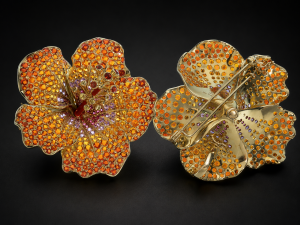
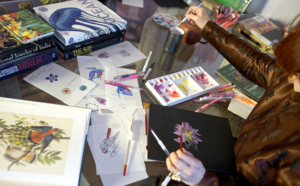
When Paula studies a flower, she may observe the structure of its petals, the transition between colors, the center of the blossom, its symmetry or asymmetry, or the way light changes its appearance.
Some of those qualities may be reproduced closely.
Others may be exaggerated, simplified, reimagined, or transformed through gemstones.
That creative decision is where authorship enters.
The result may still be unmistakably a flower, but it is also unmistakably a Crevoshay.
For a collector, the question becomes:
How has the artist changed the way I see something I thought I already knew?
That is often one of the characteristics that separates art from imitation.
6. Craftsmanship Should Serve the Artistic Idea
Exceptional craftsmanship is essential to important jewelry, but craftsmanship alone does not necessarily make a jewel collectible. What matters is how technique supports the artistic concept.
A complex piece may require engineering that the wearer never sees.

Settings may be designed to allow light to enter gemstones in a particular way. A flower may need dimensionality so that it appears alive rather than flat. A butterfly may need delicacy and movement without sacrificing structural integrity.
Even the back of an important jewel can reveal how seriously its maker approached the work.
For collectors, examining craftsmanship means looking beyond the obvious question of whether something is simply “well made.”
Look at how the piece is constructed.
How are the stones oriented?
How does it move?
How does it sit on the body?
Are technical decisions being made simply to hold the materials together, or are they contributing to the artistic effect?
The finest craftsmanship often disappears into the finished work because it allows the idea to feel effortless.
That effortlessness is part of the magic.
A jewel may appear spontaneous and alive, even though achieving that effect required extraordinary precision, patience, and technical skill.
7. Provenance Gives a Jewel a Life Beyond Its Materials
As jewelry moves through time, its history can become increasingly important.
Who created it?
When was it created?
Was it one of a kind?
Was it exhibited?
Was it published?
Did it belong to a notable collection?
Has its history been properly documented?
These questions form part of a jewel’s provenance.

For a living artist such as Paula Crevoshay, there is an unusual opportunity to establish much of that history at the source.
Titles, creation dates, materials, photographs, exhibition records, artist attribution, ownership records, and other documentation can accompany the work from the beginning rather than being reconstructed decades later.
That documentation may eventually become an important part of the jewel’s story.
A collector is therefore acquiring not only an object, but potentially the first chapter of its provenance.
And that story can continue to grow.
A jewel may later appear in an exhibition, a publication, a museum collection, or within a family’s own history. Each chapter adds context to the work and helps preserve the story of how it moved through the world.
8. Collectibility Is Not the Same Thing as Investment
Collectors naturally wonder whether important jewelry will hold or increase its value.
But financial value and collectibility are not identical. Markets change. Tastes change. Gemstone values change. The reputation of artists can evolve over time.
A serious collector may consider those factors, but collecting solely around anticipated financial return can overlook the very qualities that make art meaningful.
A more enduring question may be:
Would I still want to own this piece if I could never predict what someone else would pay for it?
Collectors naturally wonder whether important jewelry will hold or increase its value.
But financial value and collectibility are not identical. Markets change. Tastes change. Gemstone values change. The reputation of artists can evolve over time.
A serious collector may consider those factors, but collecting solely around anticipated financial return can overlook the very qualities that make art meaningful.
9. The Collector Becomes Part of the Jewel’s Story

Once an artist-created jewel leaves the studio, its life changes.
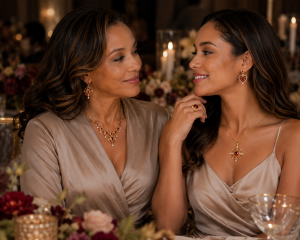
It may mark an anniversary, commemorate an achievement, become associated with a particular period of someone’s life, or eventually pass from one generation to another.
Jewelry is unusual among collectible art forms because it can be physically carried through life.
A painting may remain on a wall.
A jewel can attend weddings, celebrations, dinners, travels, milestones, and ordinary days.
It can be worn, admired, remembered, photographed, spoken about, and associated with the person who chose it.
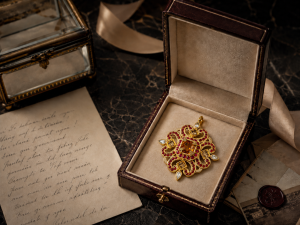
Over time, those experiences can become inseparable from the object itself.
Paula has heard stories from collectors whose Crevoshay pieces have taken on meanings she could not have known when she first created them.
That relationship between artist, object, and collector is part of what makes jewelry such a distinctive form of art.
The artist begins the story.
The collector continues it.
10. When a Jewel Becomes an Heirloom

Many people inherit jewelry from mothers, grandmothers, or other important figures in their lives.
The material value may matter, but it is often not what makes the piece irreplaceable.
The jewel becomes evidence of a person, an occasion, or a chapter of family history.
For serious collectors, this raises another consideration:
What will the next generation know about this piece?
Who was the artist?
What inspired it?
What materials were used?
Was it exhibited?
Was it one of a kind?
Why did the original collector choose it?
That information may eventually become as meaningful to future generations as the jewel itself. There is something especially powerful about knowing that an object chosen because it brought joy to one person may one day carry that person’s story forward.
So, What Makes a Jewel Truly Collectible?
There is no single formula. A collectible jewel may combine:
A distinctive artist.
A recognizable artistic language.
Exceptional or unusual gemstones.
True rarity.
Original design.
Extraordinary craftsmanship.
Documented provenance.
Cultural or museum significance.
A meaningful relationship with its collector.
But perhaps the most important quality is more difficult to measure. A truly collectible jewel continues to reveal something.
Perhaps that is one of the great pleasures of collecting exceptional jewelry: discovering a work that rewards attention again and again.
First comes beauty. Then the gemstones. The craftsmanship. The artist’s hand. The story. And eventually, the memories the collector adds to it.
At its best, a collectible jewel is not simply something rare to possess. It is something extraordinary to experience, preserve, wear, share, and one day pass forward.

For Paula Crevoshay, the transformation from precious material into art begins with seeing possibility where others might simply see a gemstone.
For the collector, the journey can begin with that same sense of discovery.
Continue Your Exploration
This exploration of what makes an art jewel collectible is only one chapter in a larger story of artistry, gemstones, craftsmanship, and discovery.
Continue exploring the world of Crevoshay through The Collector’s Letter, where we share stories from the studio, remarkable jewels, and the ideas and inspirations behind the work.
Subscribe below to continue exploring.